
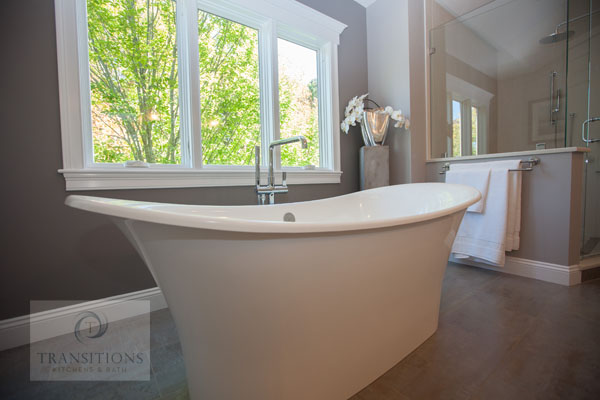
Showers have taken center stage in today's bath designs, with a variety of styles and sizes. Many people choose to forego a bathtub to make space for a larger shower. If your remodel still includes a bathtub, freestanding tubs are by far the most popular choice. Freestanding tubs are as much about form as function, with styles ranging from antique claw-foot tubs to sleek contemporary designs.
This tub style creates a clear focal point and transforms a bathroom into a soothing retreat. Here's a six-step guide.
1. What is a freestanding tub?
Any bathtub that's standalone is considered freestanding. It can be located next to a wall or in the center of the room, depending on plumbing access. Freestanding tubs are generally better suited to larger rooms, which allow for greater flexibility in positioning, though styles are available for smaller baths too.
2. What size?
One size doesn't fit all. Select a tub that's comfortable for the people using it. A larger tub requires more hot water, takes longer to fill, and can be very heavy depending on the material.
3. Where can I position it?
Once plumbing is in place, the tub can go almost anywhere. You may decide to place it in a central location if the room is big enough; this lets the tub serve as a focal point. You could also maximize natural sunlight by placing it near a window. Add privacy with blinds, including half-blinds that cover the bottom half of the window while letting sunlight in through the top. Storage near the tub can come from a niche or shelves built into a nearby wall. We dig into bath layout in our bath layout guide.
4. Which style?
There's a freestanding tub to complement any bath design. Tub styles are defined by the shape (oval, rectangular, circular, or freeform curved) and the base (feet or pedestal). Each evokes a particular mood.
5. Which faucet and plumbing?
Finish the tub with your choice of faucet, which can emerge from the tub itself, the floor, or the wall. Make sure your plumbing fits the faucet style or can be adapted. The size and style of the faucet should suit the tub.
6. What material?
Freestanding tubs come in copper, brass, cast iron, enamel, fiberglass, wood, or stone, each with its own characteristics. Beyond the look, key differences include cost, how well the material retains heat, weight, and maintenance.
Talk through freestanding tubs with a designer
If you're planning a bath and want to talk through freestanding tub options, we'd love to talk.
Schedule a showroom visit at our 5,000 square foot showroom in Norwell. No pressure, just a real conversation about your home.
Transitions Kitchens, Baths & Remodeling
433 Washington St, Norwell, MA
(781) 871-0881


.jpg)